
Teachings · Shito-Ryu after Kenwa and Kenei Mabuni
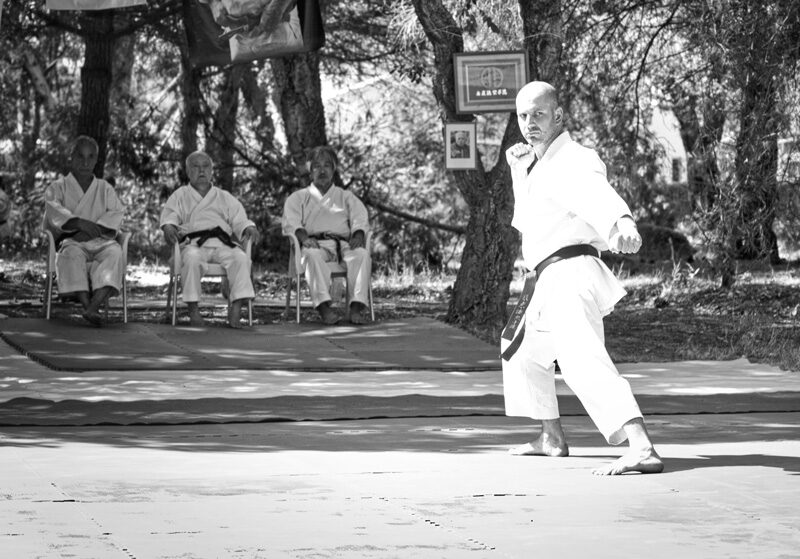
Tom Witt, 1971–2021 (6th Dan)
Tom passed his 1st Dan examination in 1993 under Kenei Mabuni in Corsica. From the beginning of his karate training in 1989, Tom devoted himself to the holistic study of Shito-Ryu. He was a karate instructor of the German Karate Federation (Deutscher Karate Verband) and “Representative of DSI Dento Shito Ryu International Germany”. He was connected to the Mabuni family through regular stays at the Honbu Dojo (the Mabuni family’s headquarters in Osaka). Tom Witt led and shaped Mu Shin Kai as sensei for more than 25 years.
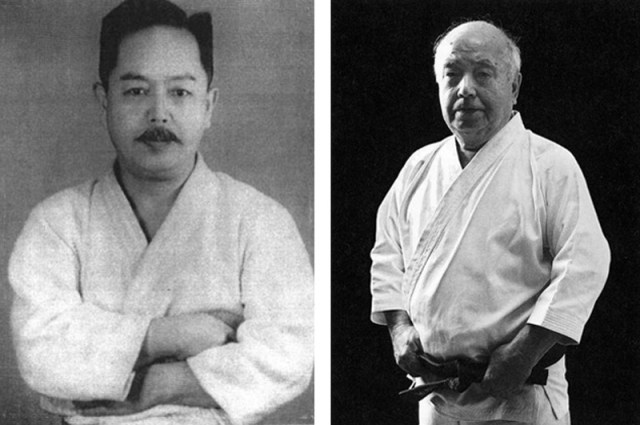
Mabuni Kenwa, 1889–1952, founder of Shito Ryu, and his son Ken’ei Mabuni, 1918–2015 (10th Dan)
空手 empty hand
Kara Te Do, the way of the empty hand, is a martial art developed in Okinawa. Besides the obvious aspect of defending against attacks, Karate Do aims at developing a healthy and strong character. The fighting aspect lies above all in recognising one's own strengths and weaknesses and working on them for a lifetime, however hard that may be. Karate Do begins and ends with respect. Karate Do is based on the three pillars Kihon, Kata and Kumite. All three must be practised equally and in harmony.
Kihon (basics)
Kihon is the basic school and therefore the foundation for Kata (form) and Kumite (sparring). Here we practise defence and attack techniques using all parts of the body, various stances, sequences of movement and combinations with and without a partner.
Kata (form)
Here, depending on the level, the prescribed sequence of combined techniques is practised. Every kata contains (sometimes in encoded form) the knowledge of a particular kind of defence or attack. This can be the imitation of animal movements as well as proven fighting techniques of a karate master. When practising kata, knowing and applying the fighting techniques from the kata is essential. In Shito-Ryu, the application of the techniques in the kata is taught from the very beginning, appropriate to each student’s level. If this is neglected, the kata loses its meaning and with it its rhythm, its dynamics and its applicability.
Kumite (sparring)
Here the techniques learned in Kihon and Kata are applied at different levels. Beginners get a feeling for distance, contact and evasion through playful sparring (light contact with open hands). Advanced students practise at different levels, from prearranged sparring (with limited techniques) to free sparring (using all techniques learned).